
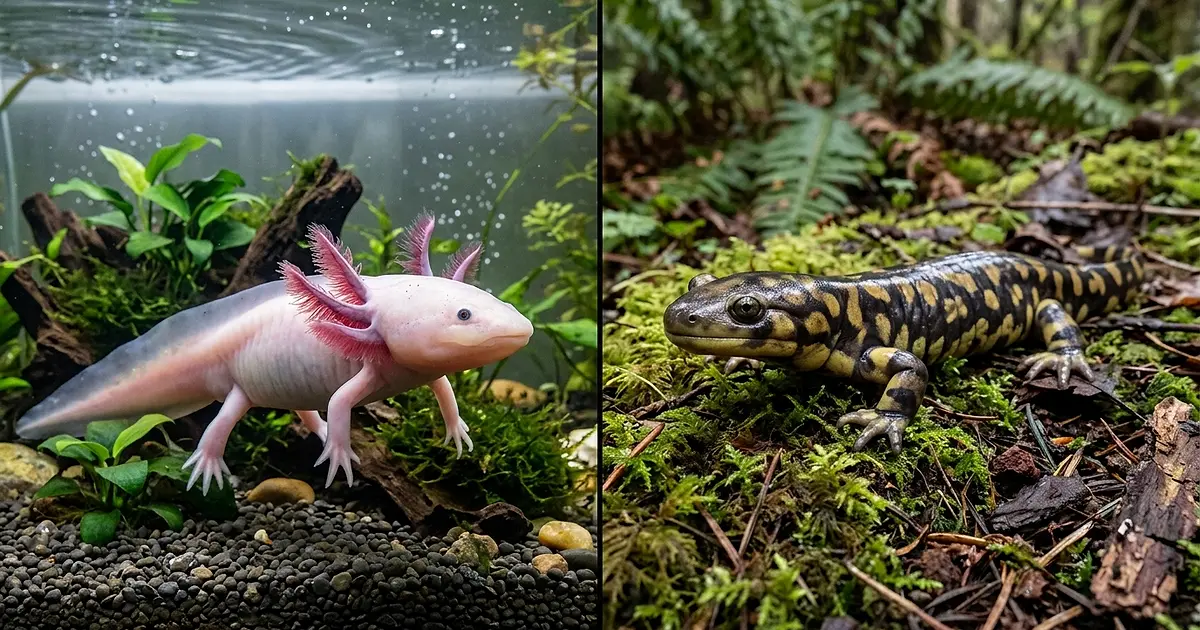
People often confuse axolotls with other salamanders, newts, or even fish. Here is how they differ and why axolotls are in a category of their own.
Axolotl vs Salamander
| Feature | Axolotl | Most Salamanders |
|---|---|---|
| Habitat | Fully aquatic (lifetime) | Aquatic as larvae, terrestrial as adults |
| Gills | External gills (permanent) | Gills absorbed during metamorphosis |
| Metamorphosis | Does not occur naturally | Normal part of lifecycle |
| Eyelids | No eyelids | Eyelids develop after metamorphosis |
| Skin | Smooth, slimy, permeable | Drier, thicker in adults |
| Reproduction | Breeds in aquatic form | Most breed on land |
| Regeneration | Extraordinary (limbs, organs, brain) | Some regeneration, but limited |
Axolotl vs Newt
| Feature | Axolotl | Newt |
|---|---|---|
| Family | Ambystomatidae | Salamandridae |
| Habitat | Fully aquatic | Semi-aquatic (water + land phases) |
| Gills | External (permanent) | Absorbed in land phase |
| Skin toxicity | Not toxic | Many species are toxic |
| Size | 20-30 cm | 7-15 cm (most species) |
| Native | Mexico only | Europe, Asia, North America |
Axolotl vs Mudpuppy
The mudpuppy (Necturus maculosus) is the animal most commonly confused with axolotls because it also keeps external gills as an adult.
| Feature | Axolotl | Mudpuppy |
|---|---|---|
| Scientific name | Ambystoma mexicanum | Necturus maculosus |
| Native | Mexico (Lake Xochimilco) | Eastern North America |
| Size | 20-30 cm | 20-45 cm (larger) |
| Color | Many morphs | Brown with spots |
| Gills | Feathery, can be very large | Bushy, maroon-red |
| Head shape | Wide, flat, rounded | More elongated |
| Pet trade | Very common | Rare, mostly wild-caught |
| Conservation | Critically Endangered | Least Concern |
Axolotl vs Olm
The olm (Proteus anguinus) is another neotenic salamander that keeps gills for life, but lives in European caves.
| Feature | Axolotl | Olm |
|---|---|---|
| Habitat | Lake Xochimilco | European cave systems |
| Color | Many morphs | Pale pink (cave-adapted) |
| Eyes | Small but functional | Vestigial (nearly blind) |
| Lifespan | 10-15 years | 50-100+ years |
| Size | 20-30 cm | 20-30 cm |
Why Axolotls Are Special
Among all salamanders and amphibians, axolotls stand out for:
- Neoteny: they are one of very few species that naturally remain in larval form
- Regeneration: the most complete regeneration of any vertebrate
- Genetic diversity in captivity: over 20 color morphs bred in captivity
- Scientific importance: one of the most studied animals in biology, with a fully sequenced genome
- Cultural significance: named after an Aztec god, featured on Mexican currency
FAQ
Frequently Asked Questions
Frequently Asked Questions
Is an axolotl a salamander?
Yes, technically. Axolotls belong to the salamander family Ambystomatidae. They are a specific species of mole salamander (Ambystoma mexicanum). What makes them unique is that they never undergo metamorphosis like other salamanders.
Can you keep a salamander like an axolotl?
Most salamanders need a terrestrial or semi-aquatic setup, unlike the fully aquatic axolotl. Tiger salamanders are the closest relatives that can be kept as pets, but they need land areas and a very different tank setup.
Keep Reading
Related Articles
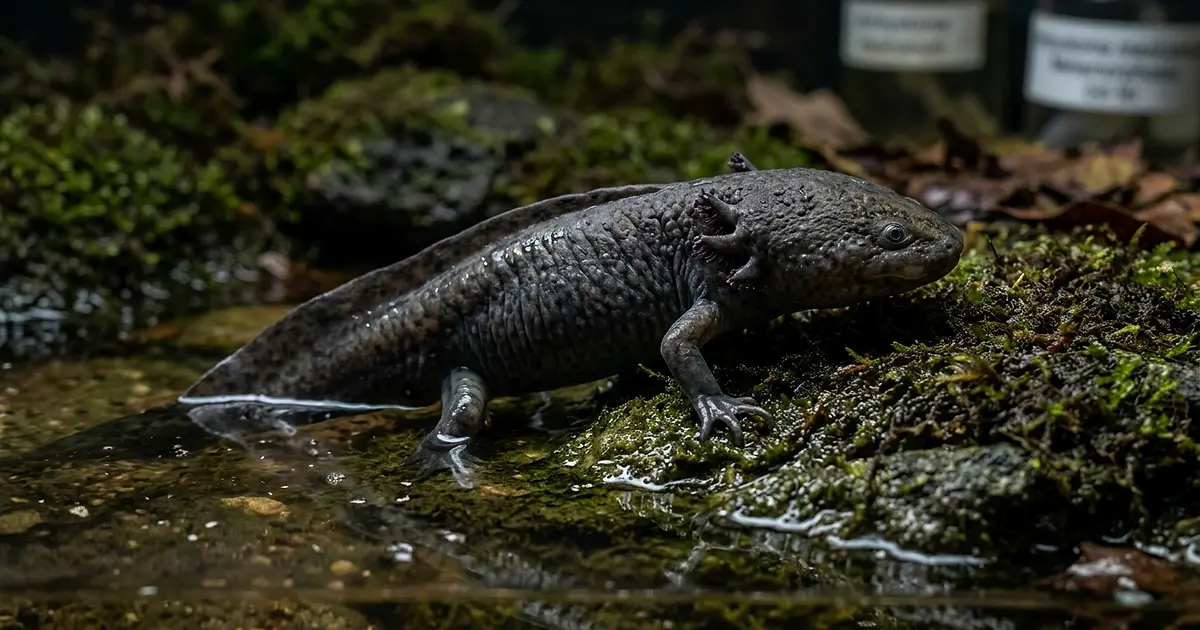
Axolotl Metamorphosis: When Axolotls Turn Into Salamanders
Can axolotls transform into land salamanders? What triggers metamorphosis, why it is dangerous, and what a morphed axolotl looks like.
Read more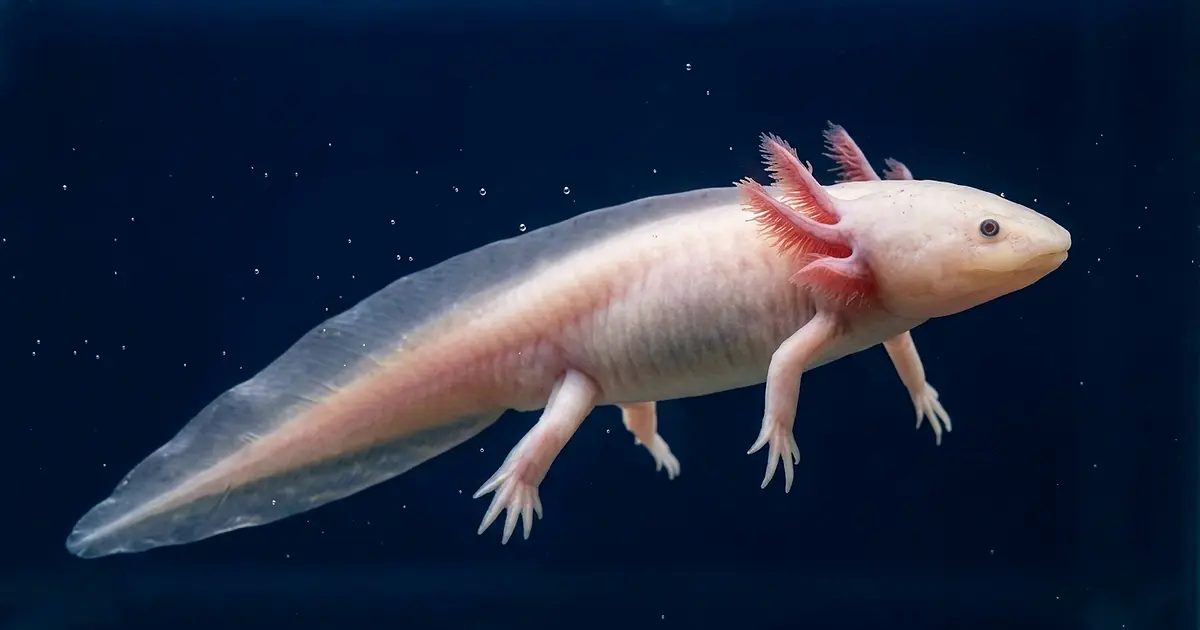
Axolotl Anatomy: Gills, Teeth, Eyes & Body Parts
Detailed look at axolotl anatomy: external gills, teeth, eyes without eyelids, limbs, skin, and internal organs. How their body works.
Read more